Meta Pixel: What Data It Collects and the Privacy Risk
At a glance
Meta Pixel
Privacy riskWhy High?
High- Category
- Advertising / conversion tracking
- Sends data to
- Meta (Facebook, Instagram)
- Still in use?
- Yes, widely
- Collects hashed PII?
- Yes, with advanced matching
- DataTrue detects it as
Facebook PageviewImpressionConnect
Summary
The Meta Pixel is Facebook and Instagram’s advertising tag. It sends Meta the pages a visitor sees, the buttons they click, and HTTP header data, which may include their IP address and browser, tied to a Meta cookie. With advanced matching turned on, it also sends hashed personal data such as email and phone. That makes its privacy risk high.
What is the Meta Pixel?
The pixel measures what people do on your site after seeing or clicking a Facebook or Instagram ad, and builds audiences for retargeting. According to W3Techs (September 2026), the Meta Pixel is on about 9% of websites, second only to Google Analytics among the tools it tracks.
What does the Meta Pixel collect?
On page load and on events, the pixel sends data present in standard HTTP headers, which may include the visitor’s IP address and browser information, along with the page location, document, and referrer. It collects the Pixel ID and the Meta cookie, it tracks buttons clicked, the labels of those buttons, and pages visited as a result, and it sends form field names, such as email or address. With advanced matching enabled, it also sends customer data the site holds, hashed with SHA-256, including email, phone, first and last name, city, state, zip, country, date of birth, gender, and an external ID.
Where does the data go?
To Meta, which uses it to measure how ads perform and to build audiences for ad targeting.

With and without consent
The pixel can fire as soon as a page loads, which is before a visitor has made a consent choice, unless your consent setup blocks it until they opt in. Advanced matching sends hashed personal data when it is turned on, either automatically in Events Manager or manually in code, so check whether it is on for your pixel. This is exactly the kind of behavior worth confirming rather than assuming.
Privacy risk:High
The Meta Pixel rates high on every factor in our rubric. It collects a broad set of data, including HTTP header data such as the IP address, and behavior, it can send hashed personal data through advanced matching, that data goes to a major ad platform that joins it across sites, and the Meta Pixel has been at the center of FTC, state, European and class-action cases over health and financial data. Whether any specific use is unlawful depends on the data involved, your consent setup, and the law that applies, which is a compliance question. For the cases, see Enforcement Watch. For whether the pixel is legal in your situation, see the Privacy & Compliance resources.
Privacy risk is rated on four factors: breadth and sensitivity of data collected, hashed PII, third-party sharing and reach, and documented enforcement or litigation exposure. It is a data-and-exposure read to help prioritize what to check, not a legal determination.
Is the Meta Pixel still in use?
Yes. According to W3Techs (September 2026), the Meta Pixel is on about 9% of websites. Meta also offers the Conversions API for server-side events, and Meta recommends using it alongside the pixel.
How DataTrue detects the Meta Pixel
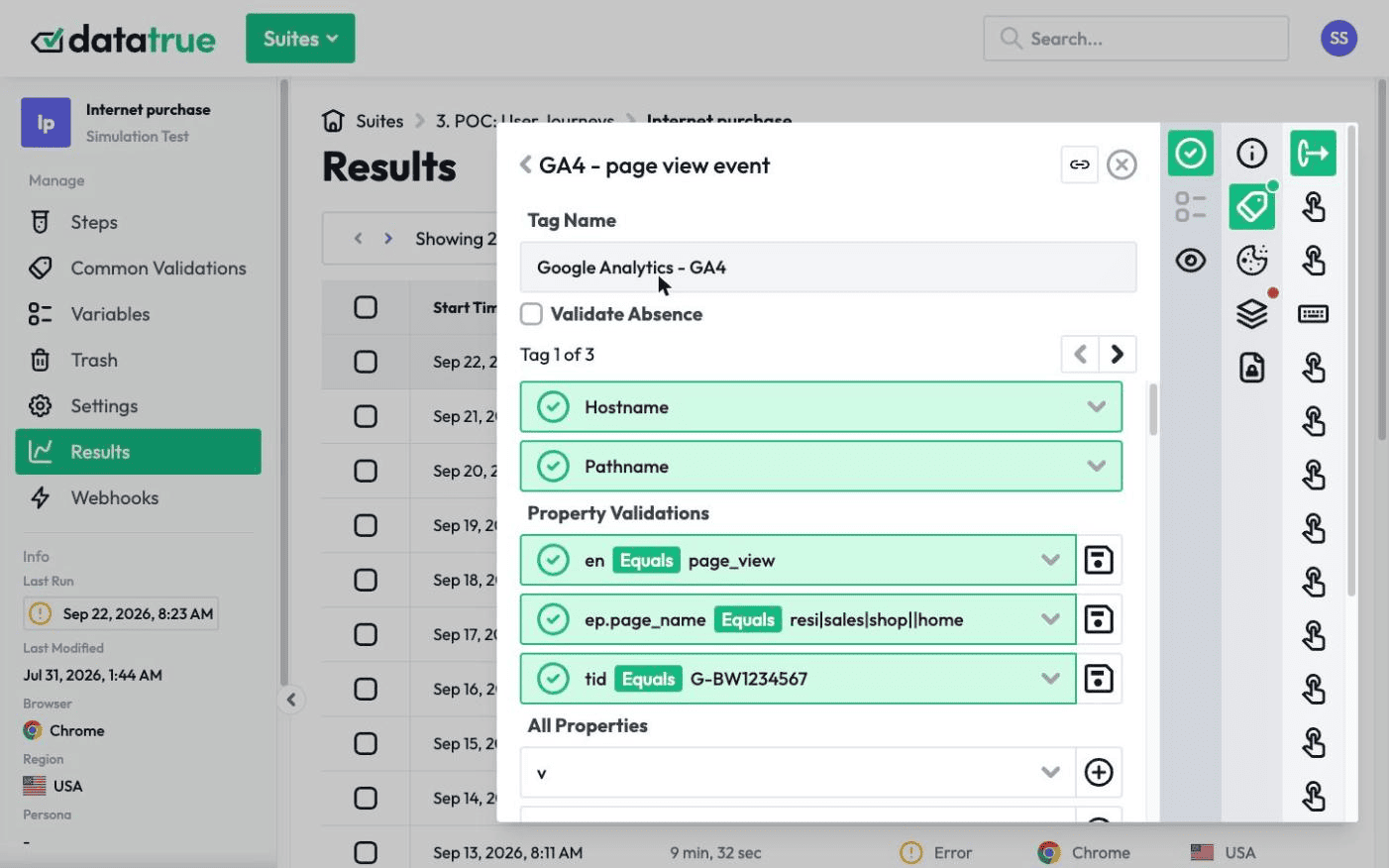
DataTrue recognizes the pixel as its Facebook tag types (Facebook Pageview, Impression, Connect). Coverage tests find it across your whole site and report where it fires, and Simulation tests read the actual payload it sends at each step of a journey and in each consent state, which shows whether it is sending personal data and whether it fires before consent. For how this works in the product, see the Web Analytics Testing page.
Questions
What data does the Meta Pixel collect?
On page load it sends HTTP header data, which may include the visitor’s IP address and browser, and the pages and buttons they interact with, tied to a Meta cookie. With advanced matching on, it also sends hashed personal data such as email and phone.
Does the Meta Pixel collect email addresses?
Yes, if advanced matching is turned on. It sends email and other personal fields hashed with SHA-256. Advanced matching can be set up automatically in Events Manager or manually in code, so check your pixel’s setting.
Does the Meta Pixel fire before consent?
It can, because it often loads with the page. Whether it waits for consent depends on your consent management setup, which is worth verifying.
Is the Meta Pixel a privacy risk?
It carries a high privacy risk because of the breadth of data it collects, its ability to send hashed personal data, and its documented litigation history. Whether a specific setup is compliant is a separate, legal question.
Sources: Meta Pixel overview, developers.facebook.com/docs/meta-pixel/. Advanced matching, developers.facebook.com/documentation/meta-pixel/advanced/advanced-matching.
Know what your tags send, page by page
DataTrue runs real journeys on your site and checks each tag’s data against what you expect, field by field. A missing event or a wrong value shows up in a test before it reaches a report.
- Every page, with coverage scans
- Scheduled runs, with alerts when a result changes
- Full journeys, like checkout and signup, in each consent state
- What each tag sent, field by field
- PII detection with test personas
- iOS and Android app testing
- Pre-publish testing for GTM and Adobe Tags
- REST API, plus Slack and Jira alerts
The full platform, every feature, free for 30 days.