Is Google Analytics GDPR Compliant?

Summary
VerdictIt depends.
Google Analytics 4 can be used in a GDPR-compliant way, but not by default. It needs consent before the tags fire and a valid basis for sending EU data to the US. The EU-US Data Privacy Framework restored that basis in 2023 and faces a pending court challenge. GA4 is defensible today with the right setup, not risk-free.
GDPR is the EU privacy law. It reaches companies outside the EU when they offer goods or services to people in the EU or monitor their behavior there, and tracking people online counts as monitoring. Two separate questions decide whether your Google Analytics use is compliant: whether you have consent, and whether the data can lawfully reach the US.
The sections below explain why Google Analytics was ruled unlawful in 2022, what changed with the Data Privacy Framework, and whether that framework is safe to rely on. They finish with what you have to do to use Google Analytics compliantly, and how to check your setup.
Why Google Analytics was ruled unlawful in 2022
In 2022, data protection authorities in Austria, France, and Italy found specific Google Analytics deployments unlawful. The problem was not analytics itself. It was that EU visitor data was being transferred to the US after the Court of Justice struck down the previous transfer framework, Privacy Shield, in 2020, leaving no adequate basis for the transfer. Those decisions are what drove the “Google Analytics is illegal in the EU” headlines.

What changed: the Data Privacy Framework
On 10 July 2023 the European Commission adopted the EU-US Data Privacy Framework, a new adequacy decision that restored a lawful basis for transferring EU personal data to US companies that certify under it. Google says it is certified under the framework. That is the development that moved Google Analytics from “no valid transfer basis” back to “transfers can be lawful,” and it is why a 2022-era flat “GA is illegal” answer is now out of date.
Is the framework safe to rely on?
Partly. As of September 2026 the framework is valid. The EU General Court upheld it on 3 September 2025, and that ruling was appealed to the Court of Justice on 31 October 2025 (C-703/25 P). No appeal ruling had been issued as of 28 September 2026. The Court of Justice struck down the previous framework, Privacy Shield, in 2020. The practical response is to treat the framework as your transfer basis while keeping a fallback in place, such as Standard Contractual Clauses with a transfer impact assessment, so a future ruling does not leave you exposed overnight.
What you have to do to use Google Analytics compliantly
Three things, and the first is the one most sites get wrong.
Collect consent before the tags fire. Under the EU cookie rules, Google Analytics may not read from or write to a visitor’s device until they agree. A tag that loads before consent is a GDPR failure in its own right, independent of the transfer question.
Keep a valid transfer basis. Rely on the Data Privacy Framework, and keep Standard Contractual Clauses and a transfer impact assessment as a fallback.
Configure for data minimization. Turn on the privacy controls GA4 offers, and do not send personal or special-category data into it.
How to check your Google Analytics setup
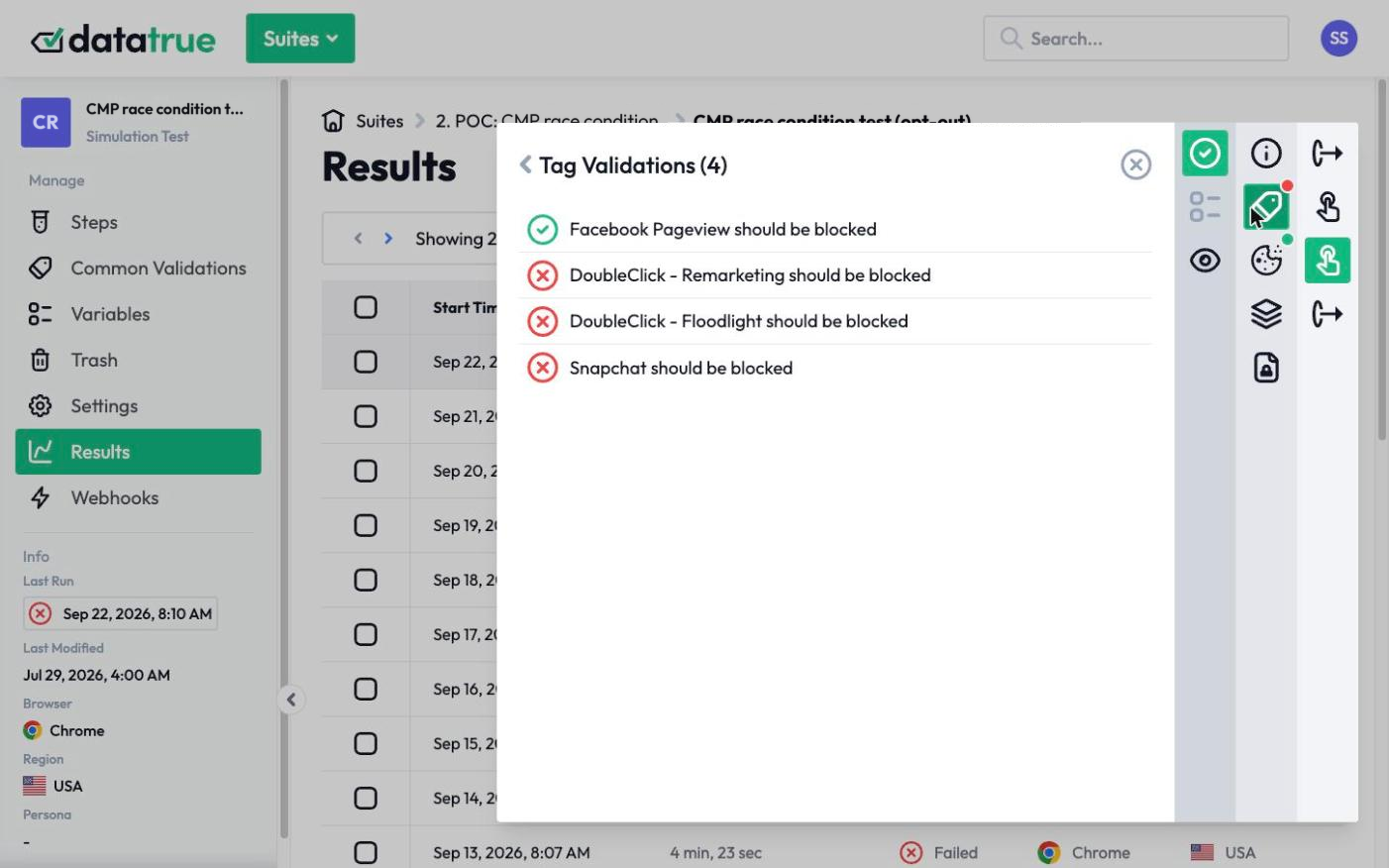
The consent half, whether Google Analytics fires before the visitor agrees, is testable. DataTrue loads your site in a real browser and records whether Google Analytics fires before the visitor consents, on which pages, and what it sends. Sensitive Data Detection inspects the payloads with fictitious personas, so you can confirm no personal or special-category data is going into GA without using a real visitor. The transfer and contract questions are handled in your privacy documentation and agreements. Testing proves the consent half.
Questions
Is Google Analytics GDPR compliant?
It can be, with consent collected before the tags fire and a valid basis for transferring EU data to the US. The 2022 rulings that GA was unlawful predate the EU-US Data Privacy Framework, which restored a transfer basis in 2023. The framework is valid but under a pending court challenge, so keep fallback safeguards in place.
Is GA4 legal in the EU?
Yes, when configured correctly: consent before the tags load, the Data Privacy Framework or Standard Contractual Clauses as the transfer basis, and no personal or special-category data sent into it. It is not legal by default, and installing it without consent gating is where sites get exposed.
Did the Data Privacy Framework fix the Google Analytics problem?
It fixed the transfer half. Google’s certification under the framework gives EU-to-US transfers a lawful basis again. It did not remove the requirement to collect consent before the tags fire, which is a separate obligation under the EU cookie rules.
Can I be fined for using Google Analytics?
The exposure is not from using analytics, it is from using it without consent or without a valid transfer basis. GDPR fines can reach 20 million euros or 4 percent of worldwide annual turnover, whichever is higher, for breaches such as processing without a lawful basis. Gating the tags behind consent and keeping a transfer basis is what avoids it.
See what your tags do in every consent state
DataTrue loads your real pages as a visitor who accepts, rejects, or sends an opt-out signal, and reads what each tag sends. A tag that ignores the visitor’s choice shows up in a test.
- Every page, with coverage scans
- Scheduled runs, with alerts when a result changes
- Full journeys, like checkout and signup, in each consent state
- What each tag sent, field by field
- PII detection with test personas
- iOS and Android app testing
- Pre-publish testing for GTM and Adobe Tags
- REST API, plus Slack and Jira alerts
The full platform, every feature, free for 30 days.