What Is Data Integrity in Analytics?
Summary
Data integrity is whether your data stays complete, consistent, and unaltered from the moment it is collected to the moment it appears in a report. In analytics, that means every event a tag sends arrives intact, with nothing lost in transit, duplicated, or quietly rewritten along the way. It is the companion to data accuracy.
What data integrity means in analytics. Data integrity is about your data surviving its journey intact. A tag fires on your site, the event travels to an analytics or ad platform, it is processed, and it lands in a report. Integrity is whether the value that started that journey is the same value that finishes it, complete and unchanged. This is a different question from a database administrator’s use of the term, which is about storage constraints and corruption. In analytics, the journey is where integrity is won or lost.
Data integrity vs data accuracy. These two work together and are easy to confuse. Accuracy asks whether the data is correct when it is captured: did the tag record the right value. Integrity asks whether that value stays complete and consistent as it moves and is stored: did it arrive whole. Data can be accurate at capture and still lose integrity if part of it drops in transit or gets duplicated. Data can also keep its integrity while being consistently wrong. You need both, and our data accuracy explainer covers the other half.
What threatens data integrity in tag-based analytics?
The risks live in the journey between collection and reporting, rather than in the analytics tool:
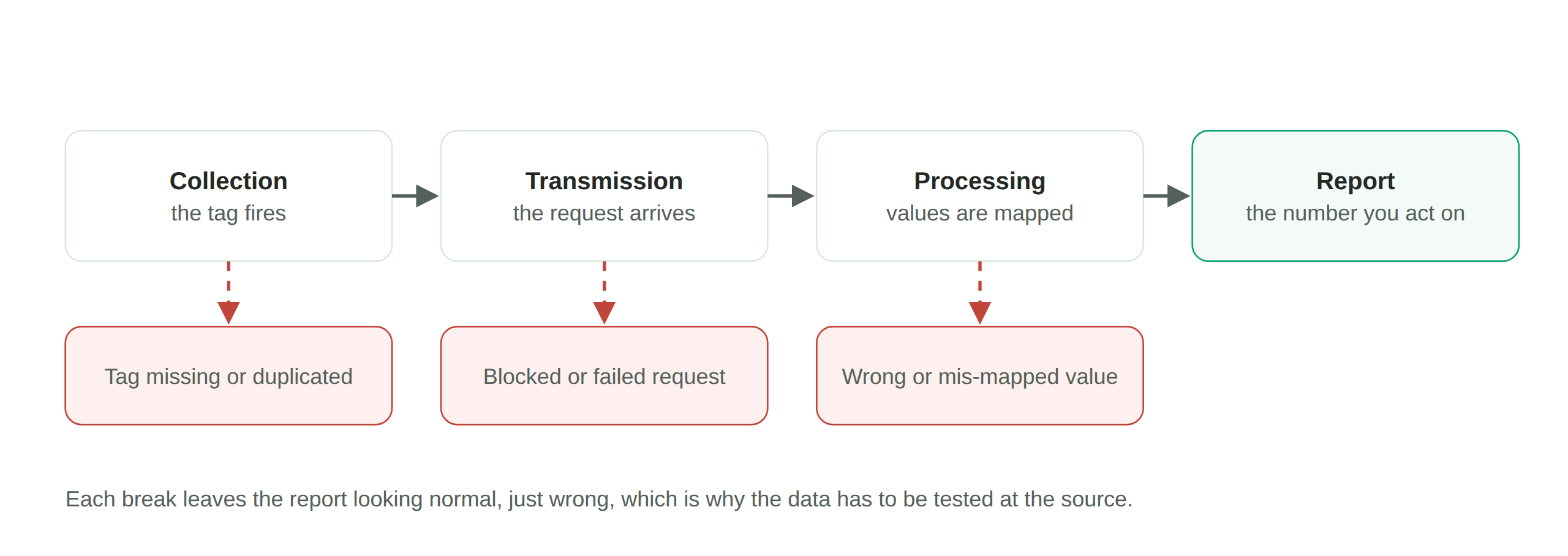
- Events lost in transit. A beacon that fails to send, a request blocked by an ad blocker or a network error, or a tag that fires too late as the page unloads. The event happened, but it never arrives.
- Consent gating that drops events unevenly. When tags are blocked before consent, the events from visitors who decline never enter your data. That is the intended effect of consent. Tools like Google’s advanced Consent Mode model some of the missing conversions, but your raw data still under-counts visitors who decline, so account for the gap when you read your reports.
- Duplication. The same event counted twice, from a hard-coded tag plus a tag-manager copy, a double-loaded container, or a retry that fires again. One action becomes two.
- Identity resets across domains or sessions. When a visitor crosses domains and their ID resets, one person becomes two, and every metric built on unique users drifts.
- Transformation errors. Data reshaped in the data layer, a tag template, or a server-side pipeline can be truncated, mis-mapped, or rounded, so the value that lands is not the value that left.
- Late or out-of-order events. In a multi-step journey, steps that arrive late or out of sequence break the funnel even when each individual event is correct.
How do you protect data integrity?
You protect it by checking the whole journey, not just the point of collection.
- Test complete journeys, not just single tags. Walk a real signup or checkout end to end and confirm each event fires once, in order, and arrives with its values intact.
- Reconcile counts. Compare what should have been sent against what the destination received, so lost or duplicated events show up.
- Account for consent. Know which events are dropped by consent choices, so a gap is understood rather than mistaken for a decline in activity.
- Watch identity across domains. Confirm identifiers persist across the domains a journey crosses.
- Validate transformations. Check the values after any data-layer or server-side step, not just before, so a reshaping error is caught.
- Monitor continuously. Journeys and containers change, so re-run these checks on a schedule and alert on drift.
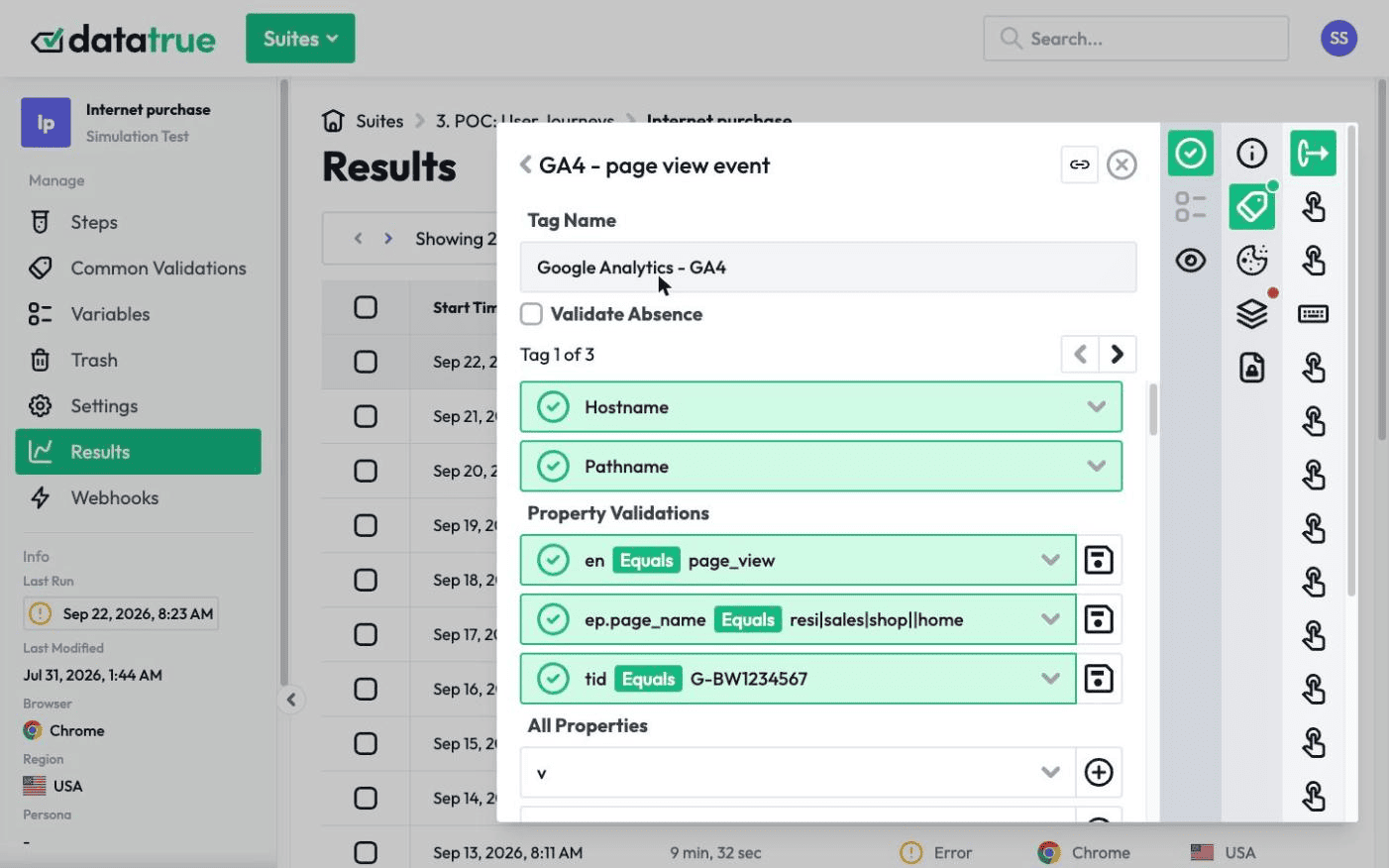
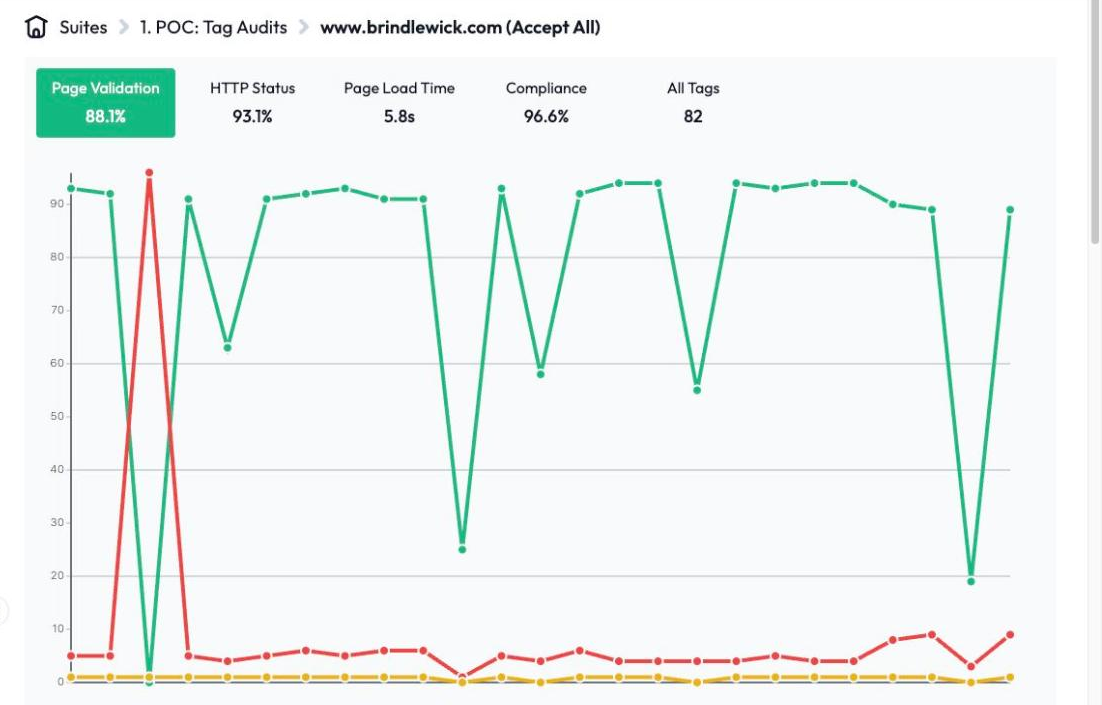
How DataTrue helps. DataTrue tests the whole path your data takes, on your live site and apps. Simulation tests walk a defined journey step by step and check what each tag sends at each step, in each consent state, which surfaces lost, duplicated, and out-of-order events. Coverage tests find duplicate and missing tags across your whole site. Because DataTrue runs as an independent cloud platform, there’s nothing of ours to install on your pages. Test visits do reach your analytics and ad tools like any real visit, so we give you our IP addresses to filter them out of Google Analytics and other reports. For the data-layer specifics, see the data layer validation feature.
Questions
What is data integrity in analytics?
It is whether your data stays complete, consistent, and unaltered from collection to report, with every event arriving intact.
What is the difference between data integrity and data accuracy?
Accuracy is whether the data is correct when captured. Integrity is whether it stays complete and consistent as it moves and is stored. You can have one without the other.
What causes data integrity problems in tracking?
Events lost in transit, duplication, consent gating that drops events unevenly, identity resets across domains, and transformation errors in the data layer or server-side.
How do you maintain data integrity?
Test complete journeys end to end, reconcile sent against received, account for consent, validate transformations, and monitor continuously.
Know what your tags send, page by page
DataTrue runs real journeys on your site and checks each tag’s data against what you expect, field by field. A missing event or a wrong value shows up in a test before it reaches a report.
- Every page, with coverage scans
- Scheduled runs, with alerts when a result changes
- Full journeys, like checkout and signup, in each consent state
- What each tag sent, field by field
- PII detection with test personas
- iOS and Android app testing
- Pre-publish testing for GTM and Adobe Tags
- REST API, plus Slack and Jira alerts
The full platform, every feature, free for 30 days.