Does Server-Side Tracking Make You Compliant?
Summary
No. Server-side tracking changes where your tracking data is processed, not whether collecting it is legal. You still need consent before data is collected from a visitor’s device, and moving collection to a server does not remove that obligation. Configured well, server-side can help privacy. Configured badly, it can hide problems.
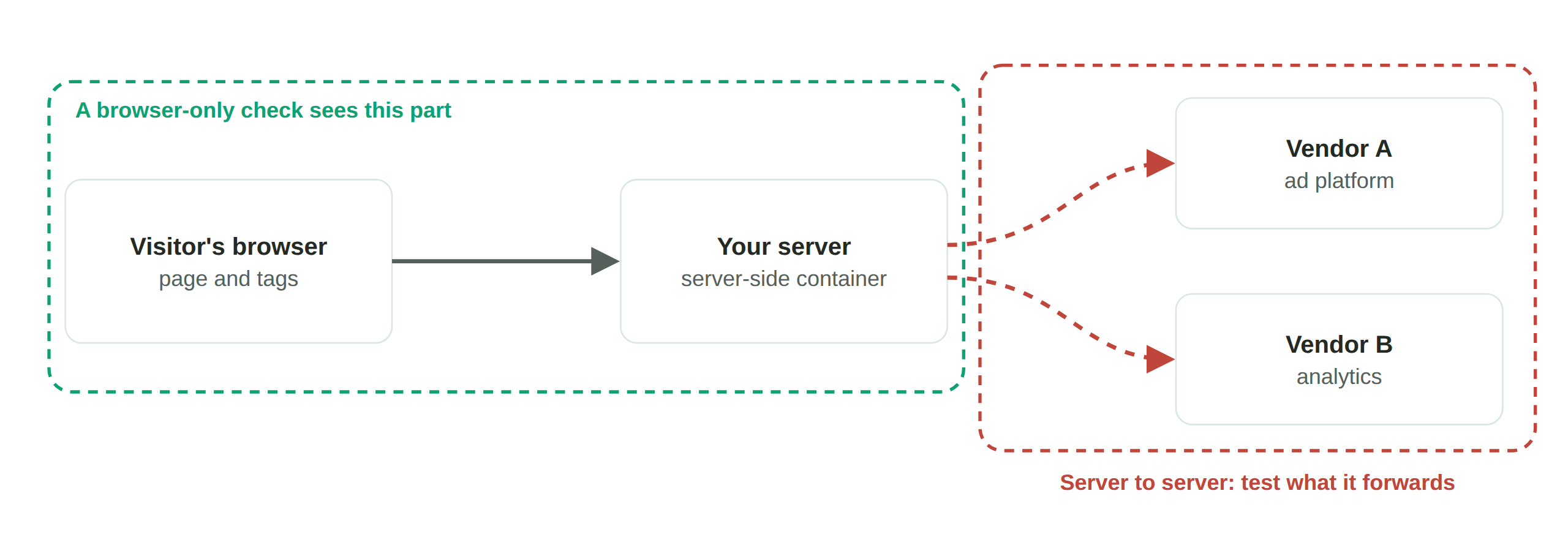
Server-side tracking is often sold as a way to sidestep privacy rules. It is not that. It is a change of plumbing that can be run compliantly or not, exactly like client-side tracking. What changes is visibility: server-side moves part of the data flow off the page, where it is harder for anyone, including you, to see what is being sent.
What is server-side tracking?
Server-side tracking sends tracking data from your own server to a destination like Meta or Google, instead of sending it directly from the visitor’s browser. The two common forms are the Meta Conversions API, or CAPI, which sends conversion events server to server, and server-side Google Tag Manager, which routes browser data through a container you run before forwarding it on.
The pitch is real as far as it goes. Server-side collection is more resilient to ad blockers and browser tracking-prevention, it keeps first-party data in your control for longer, and it lets you decide what to forward rather than letting a vendor’s script grab whatever it wants. Those are genuine engineering benefits.
Does server-side tracking make my tracking compliant?
No, and this is the misconception worth clearing up. Under the EU ePrivacy rules, the consent obligation attaches to the moment something reads from or writes to a visitor’s device, not to where the data goes afterward. Routing data through your server first does not change when consent is required. If a client-side event that feeds your server needs consent, it still needs consent.
Compliance comes from the setup, not the architecture. A server-side implementation is compliant when consent is collected before any device access, the visitor’s consent choice travels with each event to the server, each destination has its own lawful basis, and everything the server forwards is disclosed and minimized. Miss any of those and the setup is not compliant, whichever side it runs on.
Where server-side tracking adds risk
Moving data off the page introduces failure modes that client-side tracking does not have.
Consent may not reach the server. The visitor’s consent choice has to be passed to the server container with each event. When that link is missing or misconfigured, the container keeps forwarding data regardless of what the visitor chose, and nobody sees it happen because it is off the page.
Data flows become invisible. With client-side tags, anyone can open the browser tools and see what is being sent and to whom. Once forwarding happens server to server, that visibility is gone. Every downstream recipient still has to appear in your privacy policy, and it is easy to lose track of who receives what.
Hashed data is still personal data. Server-side setups often forward hashed emails or phone numbers for matching. Hashing is pseudonymization and does not anonymize the data. Hashed emails or phone numbers sent to an ad platform for matching remain personal data, because the platform uses them to match people, so forwarding them is still processing that needs a basis.
Transfers do not disappear. Sending data from your server rather than the browser does not keep it in the EEA. Each destination outside the region still needs its own transfer safeguard.
The through line is that server-side tracking can quietly do the same non-compliant things client-side tracking does, with less to see. That is why it is both a fix and a risk.
How to verify your server-side setup
The part you can test from the outside is what leaves the visitor’s browser, and that is where most of the consent failures start. DataTrue loads your site in a real browser and records every request the page makes, including requests to your own first-party or server-side collection endpoint. It confirms whether the browser sends anything to that endpoint before consent, what personal data those requests carry, and whether your consent choice actually gates them. Sensitive Data Detection inspects the payloads with fictitious personas, so you can see whether an email or phone number is going to your server-side pipeline without ever using a real visitor’s data.
That covers the client-side half, which is the half attackers, plaintiffs, and regulators can also see. The server-to-server leg that follows, what your server forwards onward and to whom, is controlled through documentation, data minimization, and your vendor agreements, since it happens where no browser test can reach. Verifying the collection point and disciplining the forwarding is how a server-side setup stays defensible.
See how consent verification works
Questions
Does server-side tracking make tracking GDPR compliant?
No. Server-side tracking is an infrastructure choice, not a compliance control. It is compliant only when the setup around it meets the rules: consent before device access, consent passed to the server with each event, a lawful basis for each destination, and disclosed, minimized data. The architecture alone does not make tracking legal.
Does the Meta Conversions API need consent?
Yes, when the underlying event involves reading from or writing to the visitor’s device or processing their personal data. Sending conversions through CAPI rather than the browser pixel does not remove the consent requirement, and the consent signal has to reach the server so events are only forwarded when the visitor agreed.
Is hashed data sent server-side still personal data?
Yes, when it is sent for matching. Hashing is pseudonymization and does not anonymize the data. Under the GDPR, a hashed email or phone number sent to an ad platform for matching remains personal data, because the platform uses it to match people, so forwarding it server-side is still processing that needs a lawful basis and disclosure.
Can DataTrue test server-side tracking?
DataTrue verifies the client-side half: whether your browser sends data to a server-side or first-party collection endpoint before consent, what personal data those requests contain, and whether consent gates them. The server-to-server forwarding that happens after collection is outside what any browser-based test can see, and is governed by your documentation, minimization, and vendor agreements.
Related guides
See what your tags do in every consent state
DataTrue loads your real pages as a visitor who accepts, rejects, or sends an opt-out signal, and reads what each tag sends. A tag that ignores the visitor’s choice shows up in a test.
- Every page, with coverage scans
- Scheduled runs, with alerts when a result changes
- Full journeys, like checkout and signup, in each consent state
- What each tag sent, field by field
- PII detection with test personas
- iOS and Android app testing
- Pre-publish testing for GTM and Adobe Tags
- REST API, plus Slack and Jira alerts
The full platform, every feature, free for 30 days.